 Marine
Understand it.
Choose with purpose.
Understand the sail, its shape and the system used to handle it.
Know the parts you are discussing
The mainsail’s leading edge is the luff, the trailing edge the leech and the lower edge the foot. These terms help you describe a problem to the loft: difficulty at the mast attachment is different from wear along the foot. Identify the corners and attachment arrangement with the sailmaker rather than relying on a photograph of a similar boat.
The existing sail is useful evidence, but it is not automatically a reliable template for its replacement. Ask the loft which measurements it will take or verify on the actual rig.
Treat reefing and stowage as design inputs
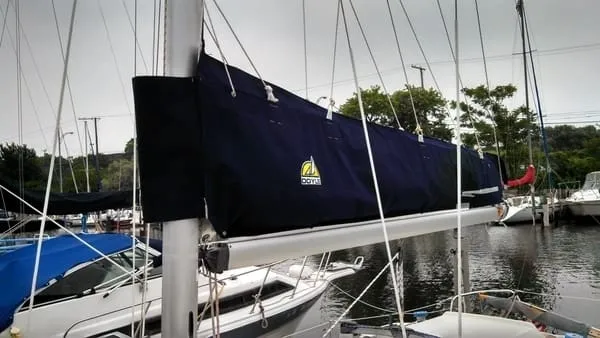
Explain how the sail is hoisted, reduced and put away, and who performs those tasks. Battens, mast hardware, covers and reefing details should be discussed together. Doyle’s mainsail reference offers examples of options; your loft should explain which arrangement suits the boat.
Describe the difficult moment in an ordinary sailing day. Is it hoisting, managing the lowered sail, or handling it with a small crew? A clear description lets the loft address the problem instead of simply reproducing the old specification.
Agree how the finished sail will be checked
Ask for a fitting appointment and explanation of the intended handling arrangement. Record which fittings and finishing details are supplied and which are retained. Compare quotations using the same headings so differences remain visible.
After delivery, use the loft’s care and handling instructions. Keep observations about fit and operation for the follow-up conversation. The first useful outcome is a sail the crew can manage and understand, with a documented route for service.
Compare the approaches
Use these differences to frame a conversation. This is a comparison of project approaches, not a ranking of brands.
| Approach | When to consider it | What to resolve |
|---|---|---|
| Conventional mainsail project | An existing hoist-and-reef arrangement | Specify battens, attachments and reefing details. |
| Furling mainsail project | A boat with a compatible furling system | Require assessment of the exact system and sail requirements. |
| Handling-focused replacement | A crew struggling with everyday sail management | Include covers and deck equipment in the discussion. |
The sail is easy to hoist but hard to put away
An owner wants to replace a main because stowing it has become a chore.
A considered approach
Show the loft the current process and ask for a proposal that addresses stowage as well as sail construction.
The brief should cover the whole sailing day.
Two mistakes worth avoiding
Leaving mast hardware out of the quote
Specify whether slides, cars or other attachments are supplied or reused.
Copying old measurements without checking
Agree who verifies the rig and final fit.
Know the terms
- Luff
- The leading edge of a sail.
- Leech
- The trailing edge of a sail.
- Foot
- The lower edge of a sail.

Turn the lesson into a useful brief.
Tick what you have gathered. Add your boat details and questions, then save a copy to take to a supplier.
Notes stay in this page and are not submitted. Download before leaving; this page does not save them.
Sources & further reading
Manufacturer and authority references for the concepts and product context discussed here. Examples and planning exercises are MarineBrands editorial; they do not imply brand endorsement or product testing.
How we research and present information →
 Cruising sails →
 Racing sails →
 Headsails →
 Downwind & code sails →