Marine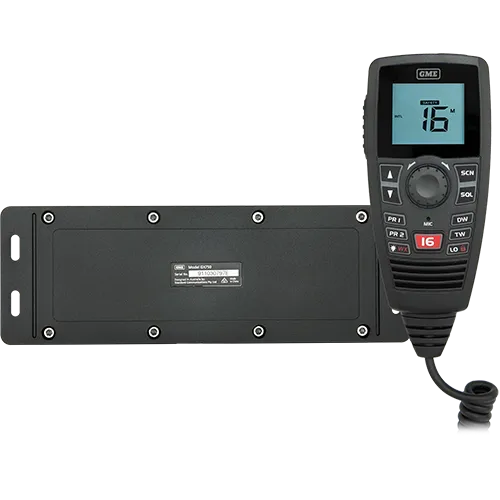
Buy around the radio’s role aboard. Portability, a fixed helm installation and a separate backup are different requirements that may call for more than one device.
Decide who needs the radio and where
List where the radio will be used: at the helm, elsewhere on deck or away from the main installation. A handheld can travel with a crew member; a fixed installation creates a permanent radio position. Compare the actual handling arrangement before making power output the deciding feature.
Think about charging, storage and access. A portable radio left flat in a locker cannot fulfil the role you intended. A fixed radio with awkward controls may be difficult for a new crew member to use. Include those everyday details in the buying brief.
Compare exact functions, not broad labels
GME’s GX875 is a handheld product example, while the GX750B uses a fixed black-box unit and a controller microphone. The two arrangements illustrate why fixed does not always mean a large dashboard faceplate. Check the model-specific function list rather than assuming a familiar appearance means identical capability.
If you want DSC, positioning or AIS-related functions, ask the supplier to identify exactly what the proposed model supports and what setup is required. These functions are not interchangeable and should not be inferred from the words marine radio.
Price the complete communications arrangement
For a fixed installation, ask about the antenna, cable route, power supply and microphone location. For a handheld, check the supplied charging arrangement, battery support and intended carrying method. Do not compare one complete package with another radio sold on its own.
Antenna arrangements and operating conditions affect communications, so avoid treating an advertised power figure as a guaranteed range. Ask the installer to explain the proposed arrangement for the boat. Keep a record of what has been supplied and how it is to be maintained.
Include operating knowledge in the purchase
Use ACMA’s current marine radio guidance to check the qualifications and procedures relevant to the intended radio and operation. Ask the supplier about any registration or identity setup required for the selected features. Buying equipment does not complete that preparation.
An illustrative cruising crew might retain a suitable fixed installation and add a handheld for a separate role. Another crew may need to replace an unreliable fixed system first. Choose from a clear communications plan and explain the equipment to everyone likely to use it.
Your planning checklist

Turn the lesson into a useful brief.
Tick what you have gathered. Add your boat details and questions, then save a copy to take to a supplier.
Notes stay in this page and are not submitted. Download before leaving; this page does not save them.
Buying questions, answered
Does a handheld replace every fixed radio function?
No. Compare the exact models and their installation requirements. Decide which functions and operating role each radio must cover.
Does a higher power number guarantee more range?
No fixed range follows from that figure alone. Antenna arrangements and conditions matter; discuss the complete system with the supplier.
Sources & further reading
Original MarineBrands buying and planning guidance, informed by these manufacturer and official references. Confirm current specifications for the exact model and Australian version.
- GME Australia · GX875 handheld VHF ↗
- GME Australia · GX750B fixed black-box VHF ↗
- ACMA · marine radio operation and qualifications ↗
This is an editorial guide. Linked brand advertorials are identified separately; no paid sponsorship or manufacturer approval of this guide is claimed.