 Marine
Understand it.
Choose with purpose.
Think about the complete hoisting and holding system.
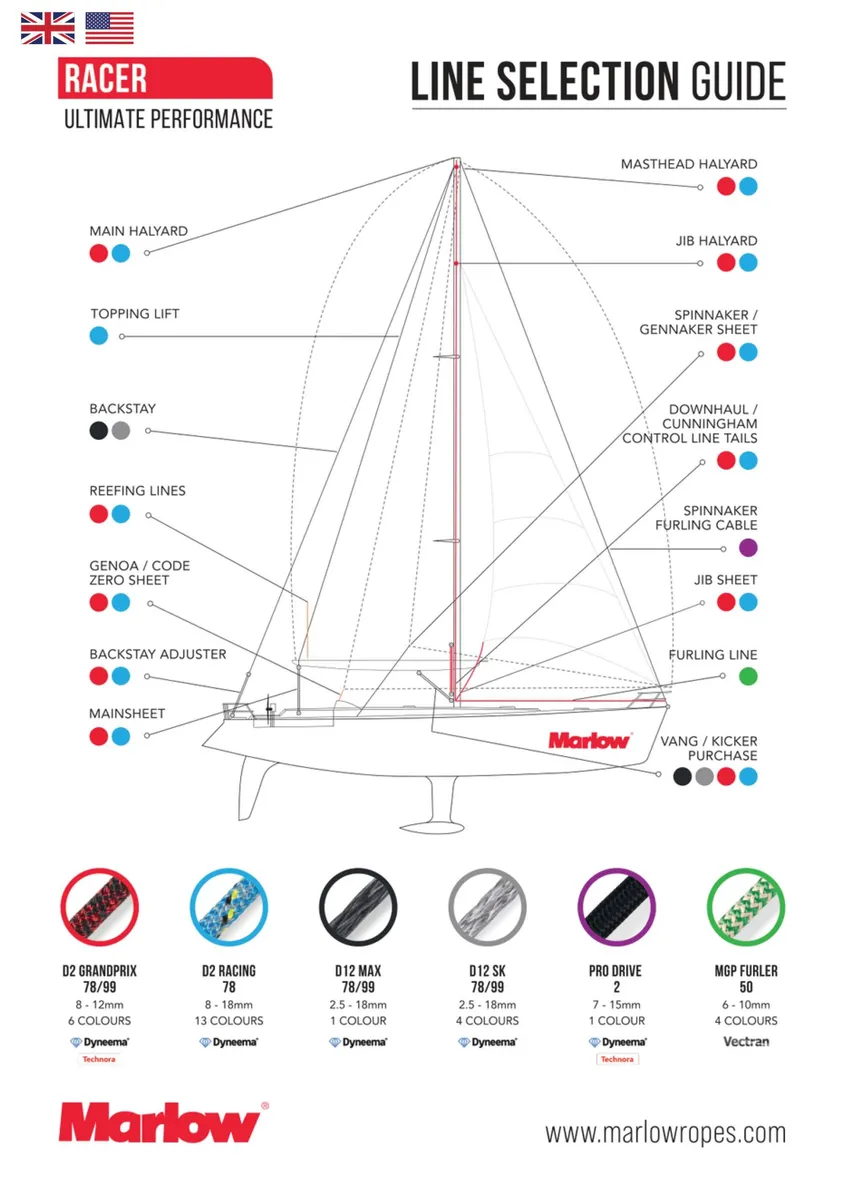
Follow the halyard’s path
A halyard raises a sail and forms part of the system that holds it in position. Follow its documented route from sail attachment through the mast arrangement to the deck controls. Identify where it changes direction and where it is held. This makes the brief about the whole system rather than a length of rope.
If the problem is movement after hoisting, describe what the crew observes. Rope behaviour, holding hardware and setup deserve assessment together. Avoid declaring the rope faulty from one symptom.
Discuss movement, compatibility and finish
Ask the rigger to explain the proposed construction for the halyard’s role. Low movement under load may be a priority, but diameter, cover and interaction with existing equipment also matter. Marlow’s rope guide discusses core, cover and deck-gear relationships.
Record the clutch, sheave and attachment details that are accessible without unsafe inspection. Let the rigger determine what further assessment is needed. Specify the finished line, not simply the bulk rope: length, ends and any required finishing belong in the proposal.
Keep a record of the replacement
Ask for a written specification and care guidance. Record which halyard was replaced and when, with observations about the removed line. This helps future service decisions and makes it easier to order a consistent replacement when appropriate.
If a line repeatedly wears at one location or does not hold as expected, seek a system diagnosis. Do not compensate by improvising with hardware settings or increasingly small rope. A controlled assessment is more useful than a series of speculative purchases.
Compare the approaches
Use these differences to frame a conversation. This is a comparison of project approaches, not a ranking of brands.
| Approach | When to consider it | What to resolve |
|---|---|---|
| Like-role replacement | A supported arrangement with normal service wear | Verify the specification rather than copying colour. |
| Performance upgrade | A clearly identified movement problem | Check compatibility throughout the holding system. |
| System repair | Repeated wear or unreliable holding | Diagnose the cause before choosing a new line. |
A mainsail seems to settle after hoisting
The owner wants to buy a more expensive halyard immediately.
A considered approach
Describe the movement to a rigger and have the line, holding hardware and setup assessed before agreeing the replacement.
A symptom is the beginning of the investigation, not the specification.
Two mistakes worth avoiding
Downsizing from a strength number
Other compatibility and handling constraints still apply.
Omitting finished ends
Clarify the delivered assembly and attachment requirements.
Know the terms
- Halyard
- A line used to hoist a sail.
- Sheave
- The wheel over which a line runs in a block or mast arrangement.

Turn the lesson into a useful brief.
Tick what you have gathered. Add your boat details and questions, then save a copy to take to a supplier.
Notes stay in this page and are not submitted. Download before leaving; this page does not save them.
Sources & further reading
Manufacturer and authority references for the concepts and product context discussed here. Examples and planning exercises are MarineBrands editorial; they do not imply brand endorsement or product testing.
How we research and present information →
 Sheets →
 Control lines →
 Blocks & pulleys →
 Winches →